Wednesday, 11 March 2015

A Profile of the Chief Justice expected to the Mutasa controversial case

Chief Justice Godfrey Chidyausiku is expected to take care of Mutasa's case and already he is under the Journalists' sharp eyes. The following story is a profile of Chidyausiku, a rather controversial profile. This profile is complicating the Chief Justice's life as it reminds the public that he is an ally of the president. It is common sense that the majority of the Zimbabwean public' opinions about this case will be shaped by this profile. Chidyausiku is now at a tight position where he has to prove to the public that he is neutral by not pleasing the ruling party. But whatever decision he'l make there will be talk, if Mutasa wins the case it definately won't go down well with the government, and if the ruling party wins it won't be considered fair by those at Mutasa's side.

Can The Judiciary Stand Up To Mugabe’s Challenge on Mutasa?

By Prince Tongogara (Radio VOP)

Chief Justice Godfrey Chidyausiku and President Robert Gabriel Mugabe
With less than two years before he bids farewell to the bench, Chief Justice Godfrey Chidyausiku is under the spotlight on how the judiciary will handle Didymus Mutasa High Court application after President Robert Mugabe said he would inquire into the educational qualifications of a judge who dares hear the case.

Chidyausiku has been at the helm of the judiciary since 2001 when he was controversially appointed Chief Justice in the aftermath of Antony Gubbay’s forced resignation. His appointment then ahead of senior Supreme Court Justices like Wilson Sandura and Luke Malaba was read to mean Mugabe rewards political correctness.

Trawling through his background reveals Chidyausiku who is well immersed in Zanu PF politics since before independence in 1980.

He was elected into parliament in the late 1970’s under ANC and served for three years till 1977. It is not clear what he did in the short hibernation from political life but resurfaces in the public life as an MP for Mashonaland East elected on a Zanu PF ticket. 

Mugabe appointed Chidyausiku into the first post-independence cabinet as deputy minister of Local Government. Chidyausiku’s tenure in the ministry did not last as he was in 1982 elevated to the powerful office of Attorney General (AG). 

The AG was the chief government legal advisor, the prosecutor general, would sit in cabinet meetings and was an ex-officio Member of Parliament. This was a position that gave him access to Mugabe more than some ministers.

Chidyausiku’s appointment as AG was the beginning of a succession of rapid rise in public office. Mugabe later appointed him to the High Court bench and was soon to become its head as Judge President. 

Political developments in 2000 after the formation of the MDC and the commencement of the chaotic and violent fast track land reform quickly brought the executive into clashes with the Judiciary in arguments that quickly turned racial.

Gubbay, then Chief Justice threatened to resign over lack of security to Judges after marauding war veterans forced their way into the Supreme Court chambers in response to a landmark land judgment that said the land reform was being implemented illegally and was therefore unconstitutional.

Mugabe saw it as an opportunity to overhaul the judiciary and shape it in the manner Zanu PF wanted. Then Justice minister Patrick Chinamasa accepted Gubbay’s resignation before it was tendered thus creating a vacancy that was not there.

Mugabe against expectation that a senior Supreme Court Judge would takeover, appointed Chidyausiku who in one leap from the High Court became the most senior Judge, Chief Justice.
Chidyausiku had one serious moment of misjudgment – in 2000 during his chairmanship of the Constitutional Commission. 

He was involved in an embarrassing wrangle with a fellow female member of the commission after trying to rescind a hefty payment for her services which Chidyausiku claimed was authorised in a "a moment of weakness".

Can Chidyausiku now stand up to Mugabe and defend the judiciary and the constitution? Can he tell Mugabe to read following sections of the constitution 164(1); 164(2)(a); 165(3)(d) and 171(1)(a) which speak of judiciary independence and the courts’ jurisdiction?

If Chidyausiku remains quiet then he is confirming Mugabe’s utterances that no court can inquire into the affairs of Zanu PF even if section 171(1)(a) gives the High Court unlimited jurisdiction in all criminal and civil matters. Will he have the spine? It a matter of time and his handling of the Mutasa case will prove how independent the judiciary is.

Chidyausiku has been challenged to show his objectivity as a senior judge. He is really in a very tight spot now, that is if he really cares about what the public will say or think about him. What I am sure of is that no-matter who wins this case, it would be unfair to the losing party and the supporters. Let's sit back and relax and patiently wait for the results.


Sunday, 8 March 2015

Mutasa and Gumbo's case still raging on

I am failing to understand the case of Mutasa and Gumbo over ZANU PF. What confuses me most is why does the president and the party say there is no case, would anyone care to explain to me. Why is the party saying there is no case and what is the constitutional law concerning that. Below is a story from RadioVop:

Lawyers Say Mugabe Warning To Judges Intimidatory,Prejudicial

Constitutional law expert and lecturer, Professor Lovemore Madhuku
Legal experts say former Presidential Affairs minister Didymus Mutasa is now unlikely to get a fair court hearing after President Robert Mugabe warned the judiciary on Friday not to entertain his case against Zanu PF and the nonagenarian.

Speaking at the official opening of Africa Chrome Fields’ (ACF’s) smelting plant in Zibagwe, Mugabe said the court application that Mutasa and former Zanu PF spokesman Rugare Gumbo had filed against him and the ruling party was not one for the judges to handle.

The president added controversially that he would also question the qualifications of any judge who would accept to hear the case.

The comments raised alarm among legal experts, with many saying that the president was pre-empting and prejudicing Mutasa’s case making and also compromising the separation of powers between the executive and the judiciary.

Constitutional law expert, Alex Magaisa, said Mugabe’s remarks were in bad taste and had the net effect of inducing fear among judges given the position he held.

“I think it’s unfortunate that the president has had to go down that route. Judges must not operate in circumstances that induce fear and intimidation.

“These statements might be regarded as pre-empting the judicial decision-making process and it also puts a dent on judicial independence. If Mutasa and Gumbo’s case has no merit, let the courts make that determination,” he said.

The United Kingdom-based lawyer added that Mugabe’s remarks suggested that Mutasa’s case had merits, and as such, the only way the president could think of to sink the matter was to intimidate judges.

“But when such statements are made, it suggests that there is real fear that the case has merit and the only way to win it is to intimidate the judges.

“This gives a poor impression at a time when Zimbabwe is slowly finding its way back into the broader community of nations,” Magaisa said.

Another constitutional law expert, Lovemore Madhuku, also tore into Mugabe saying the president was now an old man living in the past.

“I think such remarks should be condemned as irresponsible. Mugabe is an old man living in the past.

“He thinks we are still in the period 1980 to 1985 when he used to intimidate judges. But that period is over and nowadays no judge is intimidated by threats from the executive,” he said.

The University of Zimbabwe lecturer added that it was clear that Mugabe was ignorant of the law, as there was no matter that could be said to be outside the ambit of the judiciary.

“The major problem with Mugabe is that he has limited understanding of the law. He studied law in prison and he never went to a law school.

So his understanding of law is limited.

“There is no matter or dispute that cannot be brought to court. Under the constitution there is no matter that can be said to be non-judiciable. Mugabe is ignorant of this fact,” he said.

Madhuku added that Mutasa’s lawyers should capitalise on Mugabe’s remarks to dismiss the nonagenarian’s defence in court.

He also called on Chief Justice Godfrey Chidyausiku to issue a statement demanding that the executive stops interfering with the judiciary.

“What his lawyers should do when they go to court is to raise the issue that Mugabe’s remarks, as one of the respondents, were inappropriate as the matter is sub judice, and therefore his defence in court should be dismissed on that basis,” he said.

“Unfortunately, there are no remedies to the matter because a president cannot be arrested. But the Chief Justice can issue a statement like what Chief Justice Enoch Dumbutshena did in 1989 calling upon the executive to stop interfering with the judiciary,” Madhuku said.

Dewa Mavhinga, Human Rights Watch Southern Africa senior researcher, said Mugabe was undermining the independence of the judiciary.

“As a party to the court case in question, President Mugabe should not be making any comments about the chances of Mutasa’s case succeeding.

That is for the court and the court alone to decide.

“As head of state representing the executive arm of government, Mugabe’s statements undermine the independence of the judiciary and the constitutional principle of separation of powers,” he said.
Mavhinga added that Mugabe’s intimidation of judges was a clear violation of the constitution.

“President Mugabe should respect the constitution which requires that the executive cannot infringe on the independence of the judiciary and legislature and vice-versa. Such unwarranted and pre-emptive criticism of the judiciary amounts to intimidation,” Mavhinga said.

Mutasa has taken Mugabe and Zanu PF to court over what he claims was an unconstitutional party congress last December, as well as what he calls his “un-procedural” expulsion from the ruling party.

In their heads of arguments, Mutasa and Gumbo say they delayed launching their court application because many lawyers had “been intimidated into refusing to represent us”.

Opposition parties have also criticised Mugabe for his threats against the judiciary, but the veteran leader remains unfazed.

Mugabe maintains that Mutasa’s case is weak and that the courts must not entertain it.
“Regai kumboita hanya neavo vanoti tinonoman’arira party…ndiani akamboti policy yeparty, yebumbiro reparty rinotibatanidza bumbiro renyika (who said the party constitution that binds us is the same as the country’s Constitution?) the nonagenarian asked rhetorically in Zibagwe on Friday.

Two weeks ago, Mugabe also said during an interview with State television, to mark his 91st birthday, that he would want to see the judge who would agree to hear “that kind of nonsense”.

Daily News

I agree with Prof Madhuku, the judges and lawyers have been intimidated and it is very likely that Mutasa and Gumbo's case will not get a fair court hearing. Zimbabwe's politics is really scary!


Cyrene High School faces closure

When I saw a billboard written "Cyrene faces closure......." I did not put it in mind as I thought it was about some sort of resolution. I was in a car passing by the Ascot robots on my way to church so I did not get a chance to read the whole headline. It did not even cross my mind that the 'closure' meant was the actual act of closing.Below is the whole story from the Sunday News:

Cyrene High faces closure over farm acquisition

by Lungile Tshuma | Sunday, Mar 8, 2015 

Cyrene High School welcome sign
 THE Anglican Church will close Cyrene High School and Clinic if Government does not reverse the takeover of the church’s farm, a senior church official has revealed. The takeover of the farm for redistribution by Government was announced through the Government Gazette of 14 November 2014.

“Deed of Transfer 1704/87, registered in the name of the trustees in Matabeleland of the Church of Central Africa, in respect of certain piece of land situate in the district of Matobo, being Irene, measuring two thousand five hundred and forty comma eight (2 540, 8) morgen,” the Gazette reads.

A senior administrator stationed at the church’s Matabeleland headquarters who refused to be named revealed to Sunday News that the gazetting of the farm had unsettled officials who are trying to engage Government “before the situation becomes sour”.

“We are having sleepless nights looking for answers on how we can solve the issue. With the way things are, our prestigious school (Cyrene) might be closed because there are lots of activities that are being done (at the farm) to run the school.

“We do farming and when the land no longer belongs to us, it then means we will not have any say on the farm.

“There is a possibility that people can come and settle on the small portion where we are farming. Everyone is panicking and no one knows what might happen because the land now belongs to the Government and anytime they can move in people for settlement,” the administrator said.

He said the church leaders were arguing that Government does not gazette land that is owned by churches but it instead gives churches land.

Bishop Cleophas Lunga, the head of the church in Matabeleland, could not confirm that the church was contemplating the closure of Cyrene High School and Cyrene Clinic but said the acquisition of the farm “has far-reaching implications”.
When pressed to specify the implications, he refused to do so.

“We are aware of the recent developments at Cyrene High School, church and clinic. The position is that the mission was gazetted on the 14th of November 2014. This creating far-reaching implications for the institution and various activities thereon.

“We believe it was an administrative error on the part of the acquiring authority as Government policy protects church property.

“We are currently engaging Government and other stakeholders and we are sure the matter will be resolved amicably,” he said.

Contacted for comment, Mr Romiel Mthimkhulu, the chief lands officer for Matabeleland South Province declined to talk to this paper saying he was not authorised to do so.

“I cannot discuss land issues through newspapers. I am a mere employee and the person you can talk to is the director, permanent secretary or the Minister of Lands,” said Mr Mthimkhulu.

Mrs Sophia Tsvakwi, the permanent secretary, referred questions to Minister Douglas Mombeshora who could not be reached for comment.

This development comes after the acquisition of Maleme Farm which was gazetted on the same date. Both farms are in Matobo District.

Cde Abednico Ncube, the Minister of State for Provincial Affairs in Matabeleland South, said he would only be able to comment this week.

“I cannot comment on the issue because some senior officials are looking into the case. I can only have a comment next week,” he said.

Built in 1939 and named after Simon of Cyrene, who was forced to carry the cross at Jesus’ crucifixion, the school was established by Canon Paterson, an Anglican priest born in Scotland.

Work on Cyrene Mission began in 1936 when John Banks donated two farms, including a large house, to the then Anglican Diocese of Southern Rhodesia.

The school chapel was declared a National Monument in 1987.

If the boarding school is closed where would all its students go??? In the case of the clinic, if it closes where would the villagers who relied on it go to for medication and treatment?? I am sure politics is behind all this and maybe the farm was not fairly and transparently managed but closing the place is the classical definition of 'going too far'. This is about students not anyone else. Closure of the school could ruin some lives forever.I pray that the government and the church work together, with the Cyrene students at heart, to resolve this issue.

Grace Mugabe challenges Chombo

Three days ago NewsDay published the story below.......:

Chombo declares war on illegal vendors, kombis


LOCAL Government minister Ignatius Chombo yesterday declared war on illegal vendors who do not want to go to designated selling points.
BY FELUNA NLEYA
Chombo said this in Harare during the launch of a clean-up campaign which was also attended by his Environment, Water and Climate counterpart. Saviour Kasukuwere and Harare Provincial Affairs minister Miriam Chikukwa.

Buhera South MP Joseph Chinotimba was also present.
Chombo said Harare City Council had tried in vain to have vendors go to designated sites. “Your associations have communicated this to you and it is with great concern that I have learnt that some of you have decided to take the law into their own hands by defying the directives,” he said.

Local Goverment Minister Ignatious Chombo


“The time for action to ensure that all informal traders and kombi operators adhere to the city by-laws has come. I urge all of you to move to designated vending sites as well pick and drop points for kombis designated by the city council. 

“There should be no vending on road pavements, traffic intersections, road islands, middle of the road and in front of shops and offices.”

Kasukuwere said the campaign marked the beginning of a collective effort to bring back Harare’s Sunshine City status.

“I warn all perpetrators of environmental offences that we will not be bystanders, but actors in bringing environmental sanity and there are no sacred cows in that regard. As a ministry, we will use all the environmental statutory provisions at our disposal to ensure that a clean, safe and healthy environment is attained,” he said.

Chinotimba pledged to clear garbage in Mbare where thousands of residents were being exposed to diseases.

...........yesterday, Nehanda Radio published the following story:

Grace, Chombo on collision path

By Margaret Chinowaita
HARARE – President Robert Mugabe’s wife Grace has stuck to her guns on vendors — maintaining that the police should not force them out from the streets — effectively setting herself on a collision path with Local Government minister Ignatius Chombo who recently declared war on street hawkers.

First Lady Grace Mugabe
As she launched the International Women’s Day yesterday, the increasingly influential First Lady said the police should not employ heavy-handed tactics when dealing with vendors — who are desperately eking a living on the streets.

This comes as the ever-increasing numbers of vendors on the streets is presenting a big problem for councils
 — with Chombo recently declaring that government will soon clean up the streets to bring order.

Yesterday, at a local hotel in Harare, Grace however, said the police should leave the vendors to do their business.

“However, I want to urge government to ensure that a conducive environment is put in place for women’s involvement in different sectors this should include women vendors who are subjected to all kinds of ill treatment.

“Mapurisa (Police), mapurisa please, mapurisa, probably you were able to go to school and attested in the police force because your mother was selling tomatoes to pay your school fees,” said Grace.


Grace said the police should henceforth stop the practice of confiscating wares they would have raided from desperate vendors.

“Ngatiregerei kutorera vanhu zvinhu zvavo, ndakati kana vasiri kutengesera mumadesignated places taurai navo zvakanaka havarambi. Kana muine nzara musina matomatoes kweretai chikwereti hachirambwi, nekuti matomatoes iwayo amuri kutora nezvimwe zvamunenge muchitora kana zvakunzi chiburitsai tione munenge musina zvichinzi zvakaora. Isu tinenge tatorerwa zvinhu zvedu zvichinzi zvakaora tiratidzei zvakangoora kudaro. Ngatiregei kudarano veduwe tiri kutsvaga kurarama.

(Police you should desist from taking away goods from vendors. Sometimes if they are perishable goods you say they are rotten when they demand that you return them. You should return the goods even if they are rotten. If it is an issue of designated selling points you should talk to them they will not refuse.)

Almost giving orders to the police, Mugabe’s wife said the law enforcement agents should respect vendors.
“Vazvinzwa vakuru vemapurisa vagere pamberi apo, (Senior Assistant Commissioner Charity) Mai Charamba nevamwe vavo vazvinzwa. Mazvinzwa mhamha handiti.” (The police bigwigs seated in the front row have understood me.).

“The participation of women in politics and decision-making is a fundamental pre-requisite for gender equality and women empowerment,” said Grace.

“I firmly believe that eradication of poverty and economic empowerment of women as enunciated in the Beijing Declaration are the chief anchors for achieving gender equality,” she added.

A grovelling Chris Mushowe, who is the acting minister of Women Affairs and Gender Development, said the path for women is going to be easier with Grace’s entry into mainstream politics as Zanu PF secretary for women’s affairs. Daily News

I would love to see my country's streets and avenues very clean and in order (vendors and kombis operating from their legally designated places) and at the same time I would like to see Zimbabweans earning a decent living in which ever ways that are not illegal. Before I take Chombo's side I would like to find out first if there are enough designated places for vendors and kombi drivers to operate from in this country. For now I am just sensing tension between Chombo and the First Lady concerning the issue in question. The First Lady has challenged the Local Government minister and she has saved the vendors and kombi operators.

Saturday, 7 March 2015

Mugabe and Mutasa

Adapted from NewsDay


Mugabe threatens judges over Mutasa


Friday, 6 March 2015

Women on the Rise in African Politics

African Women Politicians.

Adapted from the Voice of America.

DAKAR—Africa now has three female heads of state, after Catherine Samba-Panza of the Central African Republic took office in January. Though women leaders remain the exception in African politics, activists say things are looking up.

Women are breaking into the "boys club" of the African presidency.

Liberian President Ellen Johnson Sirleaf, or "Ma Ellen," was the first in 2005 as the country emerged from 13 years of brutal civil war.
  
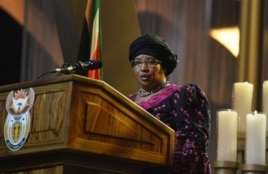
FILE - Malawi President Joyce Banda speaks during funeral service for Nelson Mandela, Qunu, South Africa, Dec. 15, 2013.FILE - Malawi President Joyce Banda speaks during funeral service for Nelson Mandela, Qunu, South Africa, Dec. 15, 2013.
​Joyce Banda stepped up in Malawi in 2012 after the sudden death of the president. She had been the vice president.

And now there's President Catherine Samba-Panza in the Central African Republic, a country torn apart by rebellion and sectarian violence.

Each of these women has taken office amid crisis and transition. Countries like Mali have seen their first female presidential candidates. Bad times are finally prying the doors open.

"There's a joke I read the other day - when everything gets messed up, the women are asked to come in and clean up," says Executive Director for the NGO Women Africa Solidarity, Oley Dibba-Wadda,

She says girls and young women are getting much-needed role models.

"To say it is possible, I can actually be a president being a woman…These trailblazers have just opened the flood doors and it's just going to happen. There is no thinking of going back. We can't go back," she said.

As African women break political "glass ceilings" at all levels of government, some are criticized for not doing enough for other women.
  
FILE - Interim President of the Central African Republic Catherine Samba-Panza gives a speech in Bangui, Feb. 1, 2014.FILE - Interim President of the Central African Republic Catherine Samba-Panza gives a speech in Bangui, Feb. 1, 2014.
Samba-Panza made it clear from day one that she would be different. About a third of her Cabinet is female.

"I intend to respect parity because until now, the previous governments didn't give us a lot of seats," she said. "There were only two or three women. But I won't choose women no matter what. I need to have women of worth, who are able to accompany my actions."

Women hold just one-fifth of parliamentary seats and ministerial positions in sub-Saharan Africa.

Discrimination remains, but the pool of qualified women is growing as more girls get to stay in school.

At least 16 African countries have passed parity laws. Countries like Rwanda reserve a percentage of parliamentary seats for women, while others like Senegal have set quotas for women on candidate lists.

The percentage of women in Senegal's legislature doubled in 2012 thanks to the law.

But prominent Senegalese politician and presidential adviser Penda Mbow says true equality requires societal change.

"Parity laws may be one tool but they are not enough. We also need to fix what goes on inside political parties and let capable, promising women emerge naturally so that when they are promoted, no one can say they got special treatment," said Penda Mbow.

Africa now has three formidable female presidents tackling everything from security to corruption. Half a century after independence, women's time may have come.
 
If our own Joice Mujuru was still in the Zimbabwean women leadership she would be one of these women. She was one of the few African women who held influential positions in politics.

Wednesday, 4 March 2015

Continuation from where we left last time:The relationship between African politics and its traditions.

Last time we highlighted that though African leaders are elected politically, at the end of the day they assume traditional power. This is seen through the way they operate once they are in the leadership seats. In the African tradition a king was succeeded only after his death,  as long as he was alive he would remain in power unless a more powerful king came into the picture and fight for that seat. So it is clear then that leadership was attained through selection, succession, or through a civil war by ambitious candidates and their followers. Lets now shift to the contemporary African politics, below is a list of longest presidents in power compiled by My Continent Africa - http://mycontinent.co/Ditactors.php


Presidents for life


These are the longest serving Presidents in power in Africa, but with President Hosni Mubarak
forced out of power and King of Kings is dead Muammar Gaddafi, Now there is a newcomer on list at number 5 and a new number one on list.


No 5: PRESIDENT YOWERI MUSEVENI of UGANDA
29 YEARS
An ex-army officer Yoweri Museveni led his National Resistance Army into Kampala in January 1986 to seize power. Since then He managed to win 4 elections on his own terms of democracy. Despite, oppositions disputed the results and recently he clamped down on demonstrators that are not happy because of corruption on his government and high living costs in country.
YOWERI MUSEVENI of UGANDA


No 4: PRESIDENT PAUL BIYA of CAMEROON
33 YEARS
In November 1982, Cameroon's first post-independence leader, Ahmadou Ahidjo,formally resigned due to ill-health, and handed the presidency to his Prime Minister, Paul Biya. Cameroon’s president, Paul Biya, described as running government finances “like a petty cash fund”, booked himself and his entourage a $1.2m three week holiday by chartered jet to the French resort of La Baule. They took 43 rooms in two luxury hotels costing $60,000 a night, went on shopping sprees and splashed cash on casino nights.” reported the US embassy in Cameroon. “When Biya traveled to the United Nations general assembly in September 2008, a member of his entourage was caught as he tried to escape from Biya’s Geneva hotel with a bag filled with 3.4m Swiss francs (about $6.8 million)in cash.”
Paul Biya of Cameroon


No 3: PRESIDENT ROBERT MUGABE of ZIMBABWE
35 YEARS
The world cheered when, after leading a long guerrilla war,Robert Mugabe led his Zanu party to victory at the elections in February 1980, after Zimbabwe had won its independence from Britain. But he is no longer a global favourite and the opposition parties accuse him of destroying his country in a bid to stay in power. The Mugabe administration has been criticised around the world for corruption, suppression of political opposition, mishandling of land reform , economic mismanagement, and the deteriorating human rights situation in Zimbabwe.
Robert Mugabe of Zimbabwe


No 2: PRESIDENT JOSE EDUARDO DOS SANTOS of ANGOLA
36 YEARS
He's nick name"quite dictator" came to power in September 1979, one month after the longest
serving President in Africa came into power. President Jose Eduardo dos Santos assumed power on the death of Angola's first president, Agostinho Neto, But for much of the time after that, he ruled only over half the country, as his MPLA fought a civil war against Unita. Now, with the war over, and Unita crushed at parliamentary two years ago elections, he is being called on to hold an election for the presidency.No firm date has yet been set.Since then he has been manipulate the weak opposition.
JOSE EDUARDO DOS SANTOS of ANGOLA


No 1: President TEODORO OBIANG NGUEMA of EQUATORIAL GUINEA
NEARLY 36 YEARS
He's now the longest serving President in Africa. President Teodoro Obiang Nguema came to power in August 3, 1979 he deposed his uncle in a violent coup d'état, supported by 600 mercenaries licensed from Hassan II of Morocco, Macias Nguema(uncle), who fled but was later captured and executed. Despite its new-found oil wealth, 60% of the people of Equatorial Guinea live on less than a dollar a day. But they clearly all love President Nguema, as he won 97% of the vote at the last election in 2002.   
TEODORO OBIANG NGUEMA  of EQUATORIAL GUINEA


From the above article one can tell that the world at large is not happy with these leaders. In the case of our own Zimbabwean president, I would like to give him credit for the Land Reform program. This program secured our land and property among us away from the foreigners' hands. Yes I know that the land was not distributed equally and fairly among Zimbabweans but what I am concerned with here is that it is owned by Zimbabweans (I think so). It is then clear that some African leaders still follow their traditions concerning leadership, the above presidents might be informed by the famous African saying that says "akulalanga eliphuma elinye lingakatshoni" which generally means there is no sun that rises before the other one sets. 

Lets meet again next time and talk about the African women in politics in relation with the African tradition !!


African Rich Presidents
5 Ways African Leaders Exit from Power.